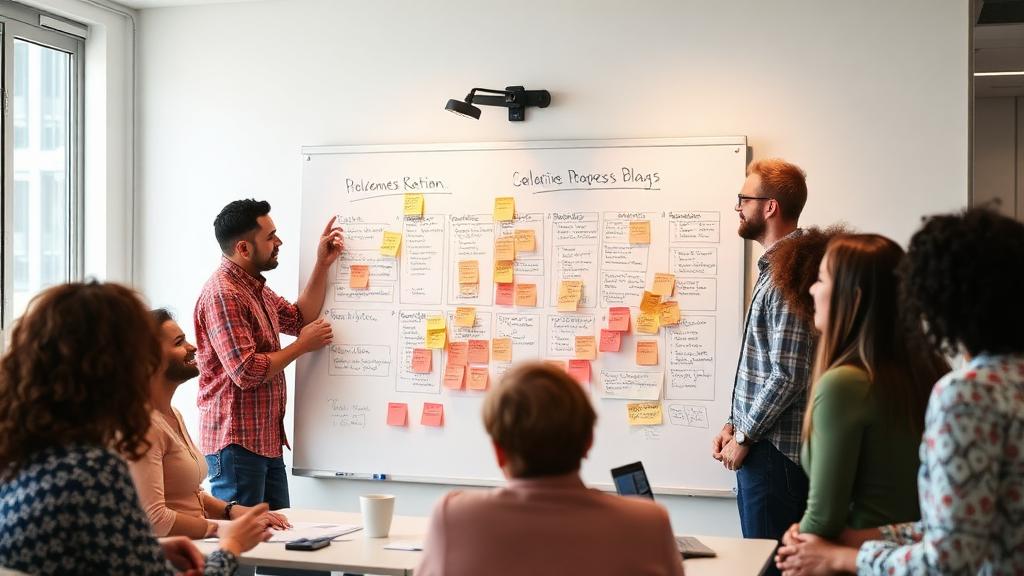
There's a lot of mystery around consulting workshops. You get an email about an upcoming "AI Strategy Workshop." You show up in a meeting room. Some consultant asks questions. Then what?
Here's exactly what happens, why we structure it this way, and what you actually walk away with.
Before You Show Up
The real work starts before the workshop. We do discovery calls with 3 to 5 people across your organization. Operations leaders, team managers, the people doing the actual work. We listen for the repetitive, annoying, resource-draining stuff.
Then we map your current processes on paper from talking to the people actually doing the work — claims intake, renewal processing, email triage, customer enquiries.
Day One: The Workshop Room
The first session starts with the 3-Step AI Audit:
- Step 1: Identify repetitive tasks. What happens every day that takes significant time?
- Step 2: Map the workflow. Walk through a recent example, step by step. Usually this is when people start saying "actually, we also do this".
- Step 3: Introduce automation. Only now, with the real process mapped, do we ask "where could AI help?"
Identifying Your Best Opportunities
We score each workflow against Repetitive, Rules-based, Resource-intensive. Usually the best opportunity emerges quickly because once you map the actual work, the bottleneck is obvious.
Building the Roadmap
- Phase 1: Quick Wins (Weeks 1–4). The simplest, most repetitive process to automate first. Define success metrics upfront.
- Phase 2: Core Improvement (Weeks 5–12). Tackle the bigger opportunity once the team sees Phase 1 working.
- Phase 3: Integration and Scaling (Weeks 13+). How does this fit existing workflows? Where are the human-oversight hand-off points?
What You Walk Away With
- A clear 16-week roadmap.
- Identified quick wins.
- An implementation team structure.
- A measurement framework.
- Confidence from your team.
Common Questions
Do I need to be technical? No.
How long does it take? The workshop itself is one day, sometimes two. Total Phase 1+2 implementation is typically 12–16 weeks.
What if we don't have a specific problem in mind? The workshop helps you identify one.
What if it fails? We start with quick wins, measure everything, build incrementally. Failure becomes much less likely.
The technology part isn't the hard bit. What's hard is understanding your process well enough to use AI effectively. A good workshop does all of that in one structured day.